
Launched Your Brand but Sales Aren't Coming? Here's What to Fix First
A quiet launch is normal. Months of silence while you keep doing the same things is not, and it usually means something specific is broken and fixable.
If your store is live and the orders aren't coming, you're in good company. Founder forums fill up every week with the same post: a month in, zero sales, money spent on ads, and a plea for someone to say what's wrong.
We went through those conversations on Shopify Community, Indie Hackers, Amazon seller forums and beauty-founder interviews, and pulled out the nine questions new founders ask most. Below are straight answers to each, followed by a short order of operations for what to fix first.
The short version: expect two weeks to two months for a first sale from a stranger. Make your page clear and trustworthy before you buy more traffic. Pick one or two channels. Collect a handful of honest reviews. And get an outside view when you can't tell what's missing.
Is it normal to have zero sales after launch?
Yes, for a while. Many new stores wait anywhere from two weeks to two months for their first sale from a stranger, meaning someone who isn't a friend or family member (Tevello).
Even brands that later do well can start slowly. Skincare founder Cristina Brooks Potts told the My Wife Quit Her Job podcast that her brand Authentic Ego had no sales in its first 30 days, then grew largely through organic mentions on Reddit and review sites (My Wife Quit Her Job).
The wait also depends on what you sell and who you already reach. A low-priced impulse item can sell quickly, a high-consideration purchase needs a longer research phase, and an existing Instagram following or email list shortens the wait considerably.
What isn't normal is months of silence while you keep doing the same things. If you're past the two-month mark with no organic sales, something specific is broken: traffic, trust or the offer. A quick first check: if your store gets fewer than 50 visitors a day, you likely have a traffic problem rather than a conversion problem.
How do you get your first customers?
Start with people who already know you or are already looking, not with cold strangers. First customers usually come from three places:
Your own network: friends, past colleagues, local groups and anyone who already knows your story.
Communities where your buyers already talk: niche forums, parent groups, local business chats. Help first, share your link second. Shopify Community members make the same point: warm, interested people are easier to win than cold ad traffic (Shopify Community).
A low-risk first step: a sample, a small starter set or a first-order bonus that makes trying you feel safe.
Ask every early buyer for an honest review with a photo. In that same thread, one member argues that early photo reviews do more for conversion than adding another app.
Why is nobody buying when people are visiting my store?
If people visit but don't buy, the problem is usually the page, not the traffic. A first-time visitor doesn't know you and is looking for a reason to trust you. The most common gaps:
It isn't clear within five seconds what you sell and why it's better.
There are no reviews, photos of real customers or other proof the brand is real.
The ad promised one thing and the page talks about something else.
Basics are missing: shipping times, returns, contact details, an About page.
Costs appear late. Tevello names unexpected shipping costs at checkout as a leading cause of abandoned carts (Tevello).
There are too many products, so nothing stands out.
Open your store on your phone as if you had never heard of it. Wherever you hesitate, a buyer leaves.
How much should you spend on ads?
Start small and treat your first budget as the price of learning, not as guaranteed sales. A common starting point for Meta ads is $10 to $20 a day (roughly $300 to $600 a month), enough to give the platform real data, and the same source suggests giving a test a week or two before you judge it (99 Dollar Social).
The better question is how much you can afford to pay for one customer and still make a profit. Zeely gives a simple example: a $100 product with $45 of costs leaves $55 of gross profit, and if you're willing to spend half of that to win a customer, your maximum cost per sale is $27.50 (Zeely). If sales cost more than your number, fix the offer, creative or landing page before raising the budget.
If you spent a few hundred dollars and got nothing, ads alone are rarely the culprit. Paid traffic exposes a page or offer that isn't converting yet, and a bigger budget only makes that result arrive faster. Fix the store first (see the previous question), then spend again. The more expensive your product, the more trust it needs, so for pricier items warm people up with content before asking for the sale.
Do you need a website if you already sell on Instagram or Amazon?
You can start without one, but a growing brand needs a home it controls. Shoppers often search a brand's name to check it's legitimate, and GoDaddy cites a statistic that 81% of online shoppers do background research before buying (GoDaddy). Finding nothing but a social profile can leave them doubting.
A marketplace account is also fragile. Feedvisor notes that Amazon sellers can be suspended without warning, and then the business has to start over, which is why it recommends a website as a fallback. The same article adds that a site lets you deal with customers directly and collect their contact details (Feedvisor).
Think of your site as the hub: every post, ad and listing eventually points back to it, and it's where you collect emails you actually own.
Instagram, TikTok, Google, Pinterest: which channel should you focus on?
Pick one or two channels and do them well. Spreading yourself across every platform at once is one of the most common beginner mistakes, and Tevello gives the same advice: choose the platforms where your buyers already spend time (Tevello). Decide based on where your customers are, not where you feel you should be.
Once you've picked, mix your content on purpose:
Mostly entertaining posts that earn reach.
Some posts that explain the product.
Some that show why you and not a competitor.
People open social apps to be entertained first and sold to second, so a feed made only of sales pitches rarely works.
How do you get your first reviews?
You don't need hundreds, just a handful of honest ones. Around ten is a sensible first target. A few ways to get them early:
Give first customers a reason to say yes. A trial price or a free sample works, as long as you ask for honest feedback and never tie the offer to a positive rating. Disclose free products where the rules require it, and check each marketplace's policy on incentivized reviews.
Follow up a few days after delivery and ask directly. Most people simply forget.
Launch a new product around a sale, such as Black Friday, so you get orders and early reviews at the same time.
If a respected expert or publication has spoken well of your key ingredient or method, mention that too. Credibility from outside your brand carries more weight than anything you say about yourself.
What if the problem is your product?
Sometimes it is, but usually not in the way founders fear. The product may be great while the reason to choose it is unclear. Ask yourself three questions:
Is there real demand for this, beyond my own excitement and my friends' compliments?
Is the market crowded with sellers offering something similar?
Can I say in one sentence why someone should pick me: a feature others lack, a better price or something genuinely new?
If you can't answer the last one clearly, your customers can't either. Talking to five or ten real buyers will tell you more than any dashboard. The Authentic Ego founder mentioned above spent about two years reading customer conversations on Reddit before launching, which is how she found the exact problem her product needed to solve
Should you do it yourself, hire a freelancer or work with an agency?
Each option fits a different stage, and the honest answer depends on what's missing.
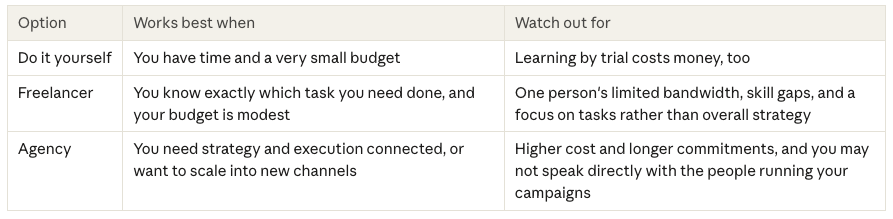
AdsPolar's small-business guide puts rough numbers on this: freelancers often suit budgets under about $2,000 a month, while agencies tend to start around $3,000 a month and may ask for three- to six-month contracts. Treat those figures as one vendor's ballpark, not a rule (AdsPolar). Many founders start with a freelancer and move to an agency as revenue and complexity grow.
The common trap is hiring someone who does exactly what you ask, only to realize you didn't know what to ask for. Whoever you choose, ask which platforms they specialize in, whether they can show results for similar clients, how they report, and what they do when performance dips. Then insist on seeing what's working and what isn't.
What to fix first: a 30-minute self-check
Fix things in this order, because each step makes the next one cheaper.
Say what you sell in one sentence. If you can't explain why someone should pick you, rewrite your offer before touching anything else.
Walk through your store on your phone. Check the headline, product photos, shipping and returns, contact details and About page. Fix wherever you hesitate.
Add proof. Collect your first ten honest reviews and a few photos of real customers.
Choose one or two channels where your buyers already are, and post a mix of entertaining, explanatory and "why us" content.
Only then, test ads. Start at $10 to $20 a day, set a maximum cost per sale, and judge results after a week or two.
Still stuck? Talk to five to ten real buyers or ask someone outside the business to look at your store.
Not sure which of these is holding you back?
Most stuck businesses aren't missing one big thing. They're missing a few small steps nobody told them about, and it's rarely about how hard you're working.
That's why we put everything above into one free guide: Successful Business Launch + Readiness Checklist. It covers 21 topics in 24 pages, from checking demand to your homepage, ads, email and seasonal sales, with 53 simple checkboxes. Tick off what you've already done, and you'll see exactly what's missing and what to fix first.
Download the free guide and checklist →
Just leave your email and we'll send it right away. No calls, no sales pitch. And if you'd rather have a second pair of eyes on your store, the guide ends with an invitation to a free 30-minute business audit.
